
Offline mzML evidence bench
Massweft: mzML Explorer
Know what the mzML file actually contains before it enters the next pipeline.
Provenance first
Inspect decoded evidence without turning a phone into a pretend desktop pipeline.
Massweft reads supported mzML binary arrays on device, retains controlled-vocabulary terms and parser notices, and binds every run to its source name, byte count, mzML version, and SHA-256 digest.
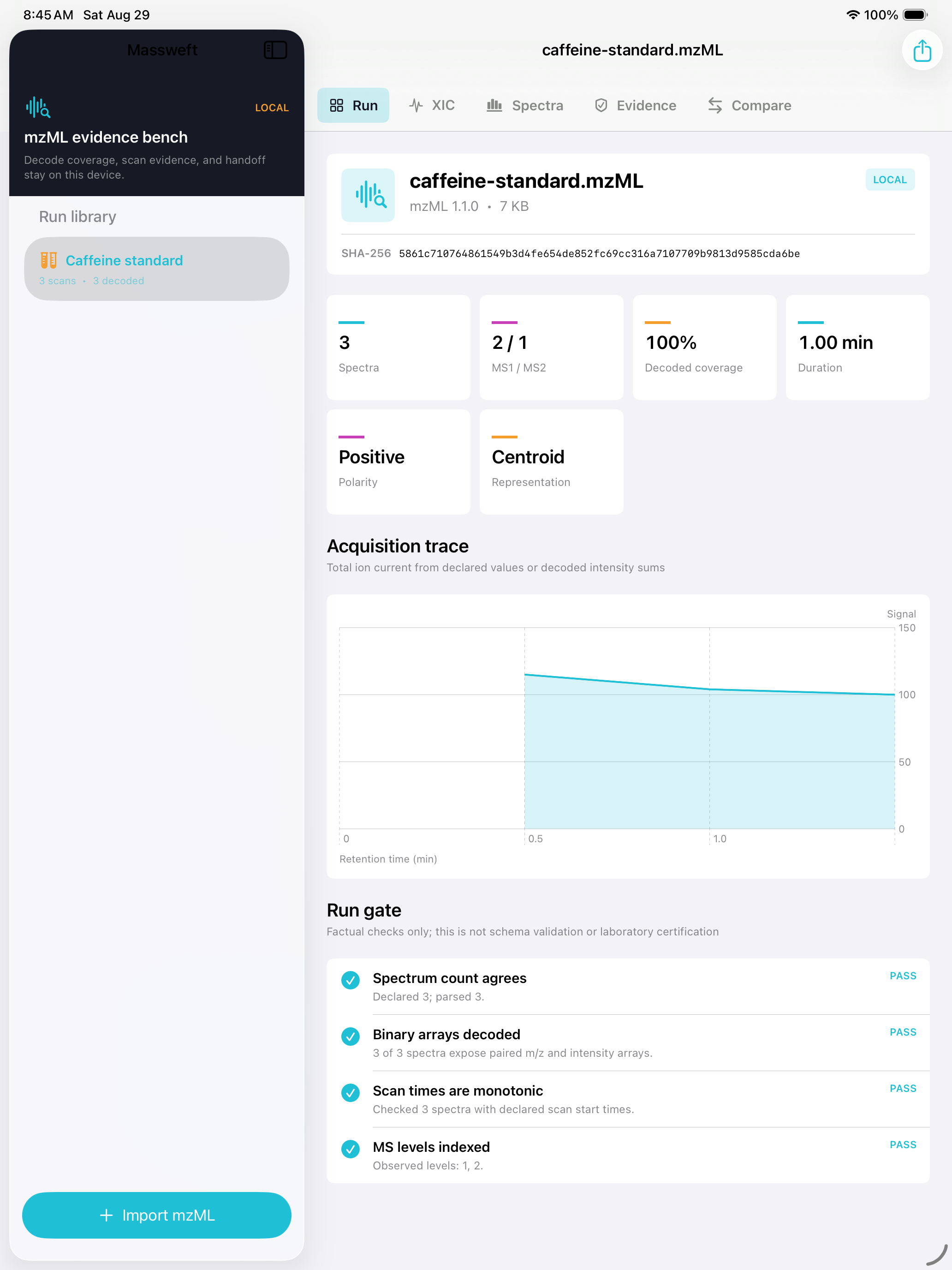
Run gate
Separate factual checks from broad validation claims.
Review declared and parsed spectrum counts, decoded coverage, MS levels, polarity, representation, scan-time order, retention range, and parser notices. Unsupported content remains visible instead of being silently accepted.
- Real little-endian array decoding
- Explicit memory and inflate limits
- Content-addressed local provenance
Trace the signal
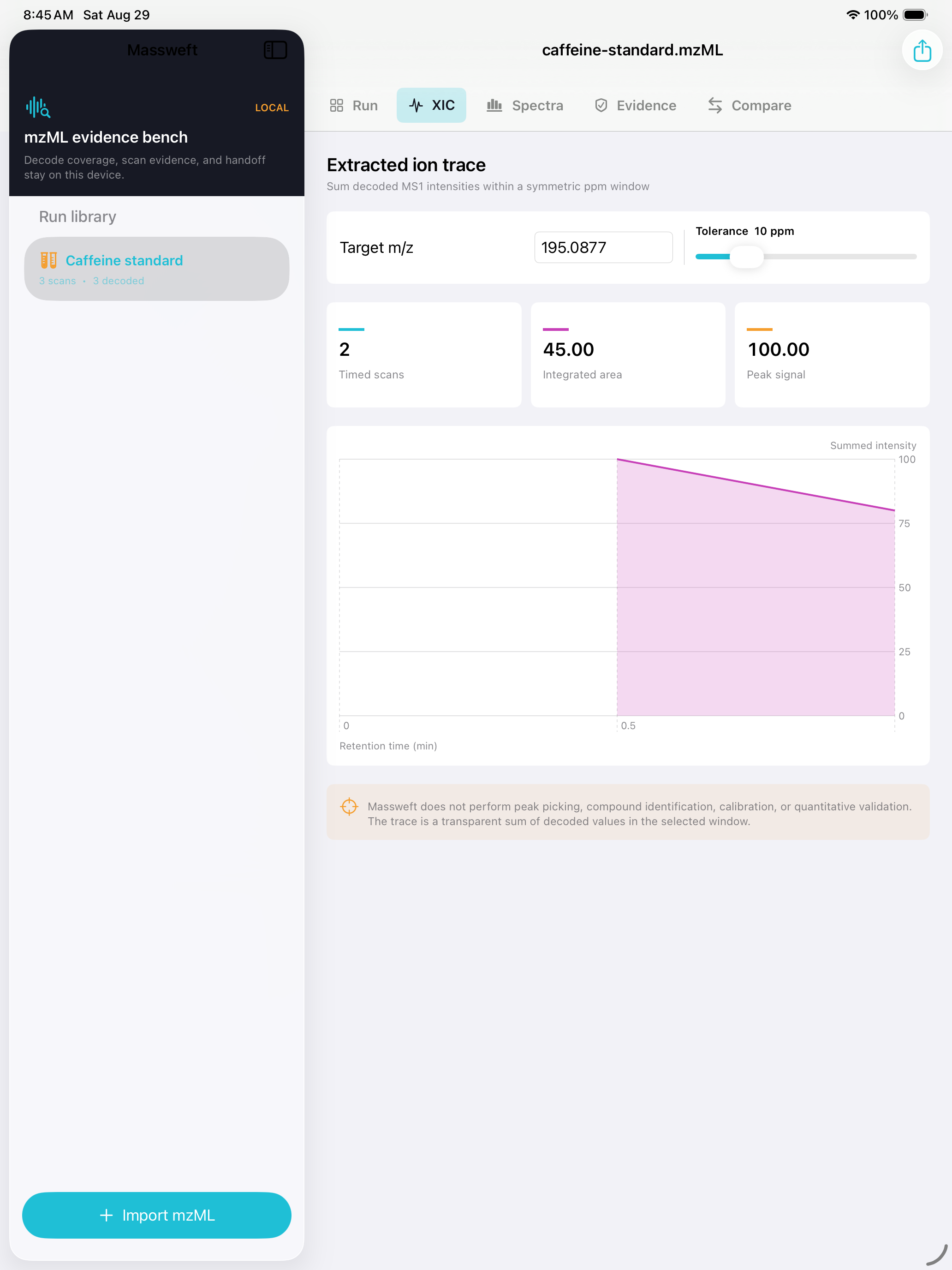
Build an inspectable XIC from decoded MS1 values.
Set a target m/z and symmetric ppm tolerance, then review timed scans, peak signal, and trapezoidal area. The app states exactly what the calculation does and does not infer.
- TIC from declared values or decoded sums
- Adjustable ppm trace window
- No compound identity or quantitation claim
Spectrum and vocabulary
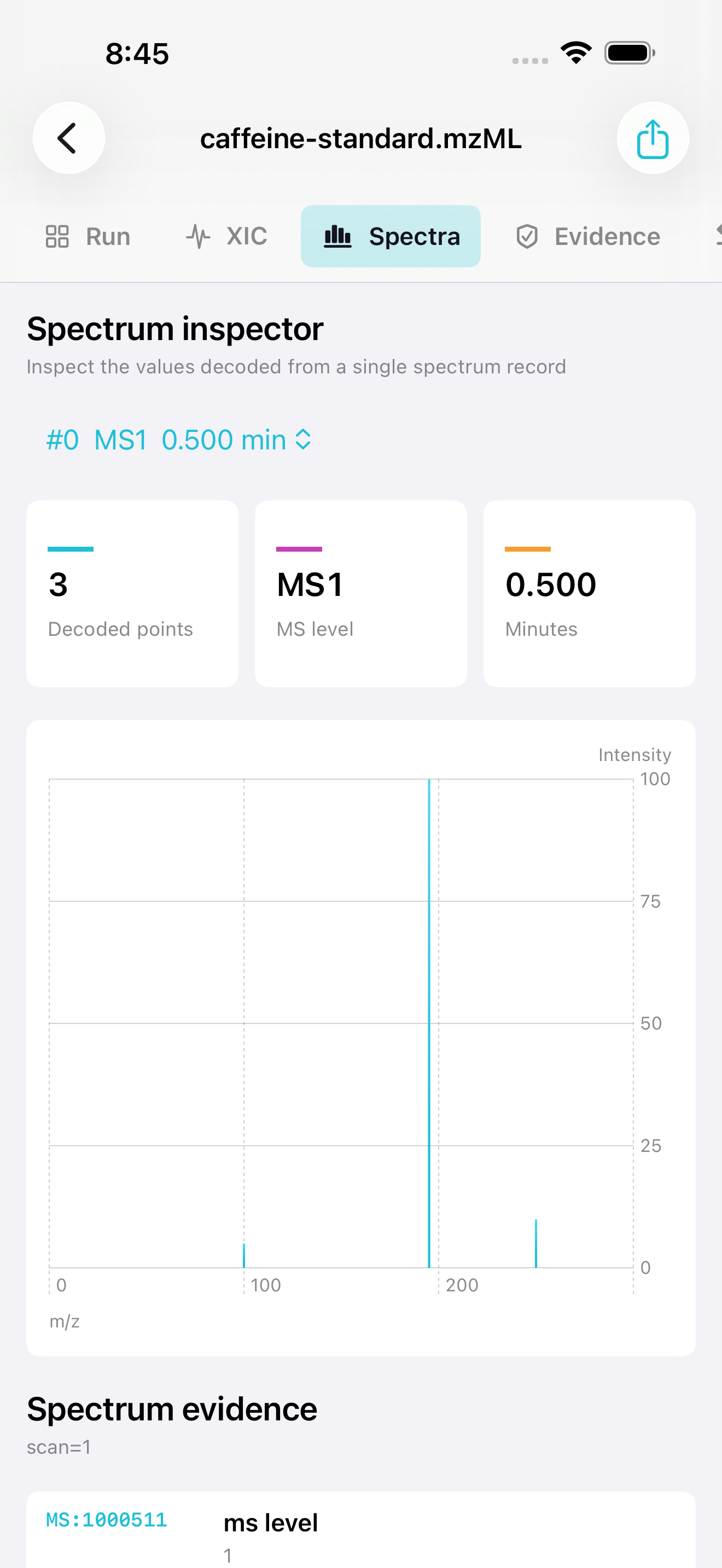
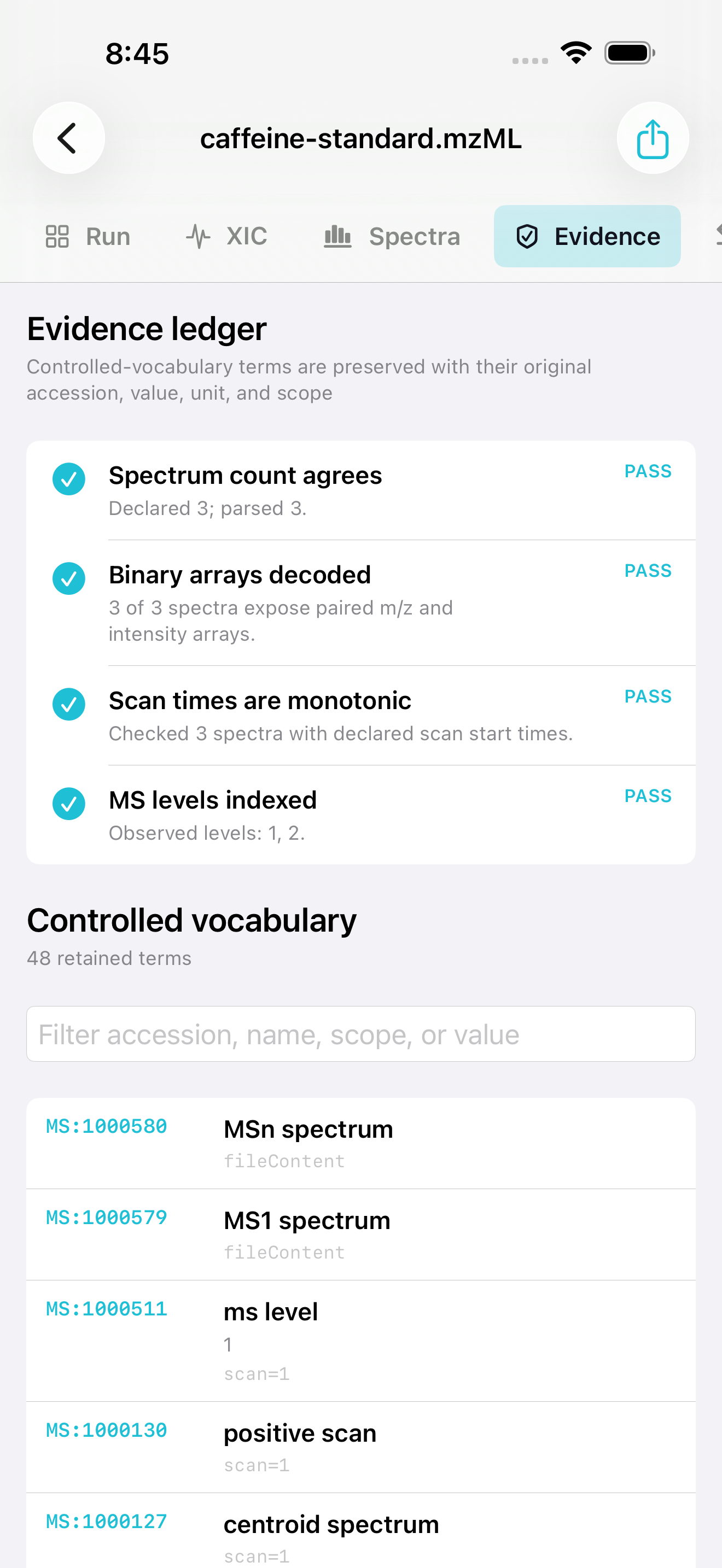
Move from a chart to the terms that produced it.
Open individual spectra, inspect decoded m/z and intensity values, and search retained PSI-MS accessions with their values, units, and source scope. Compare two runs using factual acquisition and coverage differences.
- Bounded spectrum downsampling
- Searchable controlled-vocabulary ledger
- Two-run evidence comparison
Clear scope
An evidence-review tool, not a laboratory certification system.
Massweft does not perform compound identification, peak picking, calibration, quantitative validation, clinical interpretation, proprietary vendor conversion, or complete PSI schema and semantic validation. Use an appropriate validated desktop pipeline when those functions are required.