Why It Helps
GoldenHorizon helps photographers, hikers, pilots, and sky watchers plan around light, moon phase, visibility windows, and local sky geometry. Everything runs on-device — no account, no subscription, no ads.
A sun, moon, twilight, sky-event, and outdoor photography planner for timing field work. Version 1.2 adds an NPF Night Exposure calculator and a Hyperfocal Distance calculator.
GoldenHorizon helps photographers, hikers, pilots, and sky watchers plan around light, moon phase, visibility windows, and local sky geometry. Everything runs on-device — no account, no subscription, no ads.
Build a shoot schedule around any sky target. Pick the target type (sun, moon, Milky Way, planet, ISS pass, eclipse, and more), choose your camera body from a 36-preset sensor library spanning full-frame through medium format, set focal length and location, and instantly see your horizontal and vertical field of view. Schedule a notification reminder and export the whole plan as a CSV from the share sheet.
Save named observing sites with GPS auto-fill, custom coordinates and elevation, notes, and a favorite flag. Any saved location can be pinned to a Shot Plan for accurate per-site FOV and sky calculations.
The NPF Rule (Frédéric Michaud / Société Astronomique du Havre) tells you the longest shutter speed your camera can use before stars smear into trails — accounting for your specific sensor's pixel pitch, not just focal length. Pick your camera body, set aperture and focal length, dial in the sky declination of your target, and the app computes the exact NPF limit in seconds alongside the classic 500 and 600 rule estimates. A standard shutter-speed ladder rounds the result down to the nearest real camera setting so you can dial it in immediately on location.
Find the exact focus distance where everything from half that distance to infinity is acceptably sharp. Choose your camera body, focal length, aperture, and circle-of-confusion precision (standard ÷1500, conservative ÷1730 for high-MP sensors, or fine ÷2000 for critical landscape detail). Slide the focus distance to see the near and far depth-of-field limits update live. Available in metres and feet. Covers full-frame through medium format and every sensor in the 36-body library.
36 presets spanning full-frame (Canon R5, Nikon Z9, Sony a7RV, Leica SL3), APS-C/H, Micro Four Thirds, one-inch, and medium format (Fujifilm GFX100S, Hasselblad X2D). Each preset computes true horizontal and vertical FOV and shows the 35mm equivalent focal length. A "Custom" entry in every category lets you dial in any sensor width.
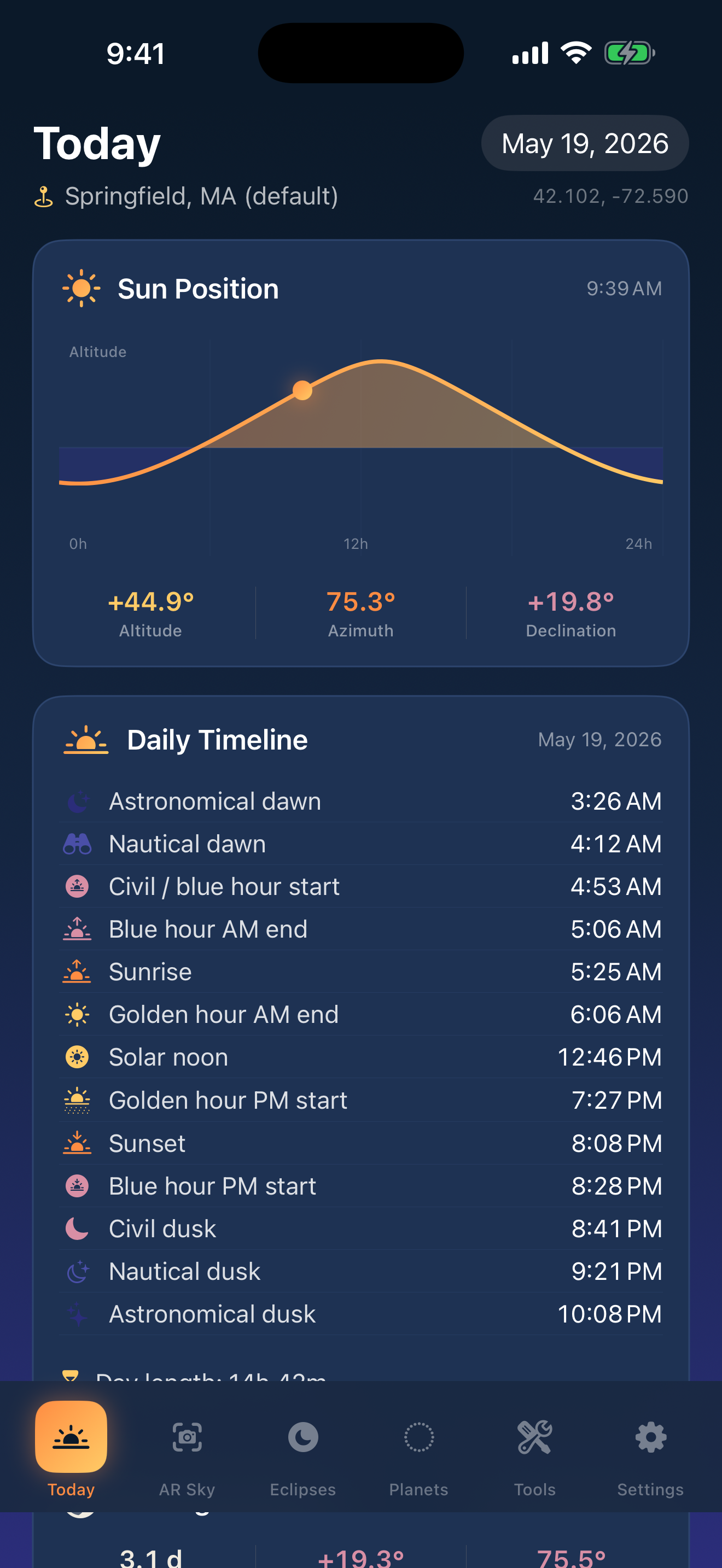
This image shows the current iPhone app interface prepared for review-facing screenshots.
All calculations use on-device algorithms: NOAA/Meeus Spencer 1971 series for solar position, Meeus 1998 low-order series for lunar position, JPL Keplerian elements (Standish) for Mercury through Saturn, and the NPF Rule (Michaud / Société Astronomique du Havre) for maximum star-exposure time. No internet connection required. No data leaves the device. Last updated June 15, 2026.